
The Truth About Certification in NLP: A Consumer Guide for Pakistan
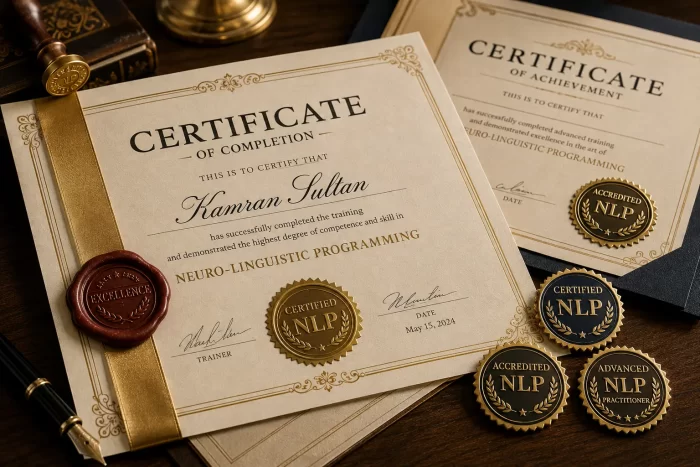
If you’re looking into NLP training in Pakistan, you’ve probably noticed something: nearly every trainer’s certificate wall is stacked with American acronyms ABNLP, INLPTA, IANLP one logo on top of another, like a résumé competition. It can sound official. It can even sound as though there is a central authority somewhere deciding which NLP certifications are legitimate and which aren’t.
There isn’t.
I keep seeing the same confusion among students in Pakistan: the assumption that more logos, more seals, or an American-sounding name on a certificate automatically means better training.
It doesn’t.
This post isn’t a complaint about any trainer or any particular certificate, nor is it about telling you which NLP organization to choose or which certificate is “the best.”
It’s about explaining what is actually true about NLP certification, so that if you’re considering spending your time and money on training, you can make that decision based on real information rather than assumptions.
NLP Is an Unregulated Industry
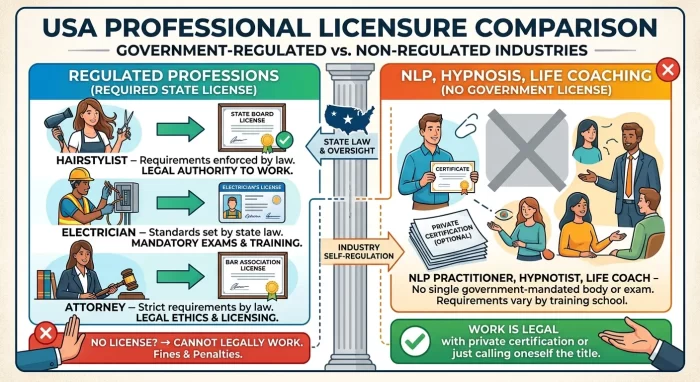
“Unregulated” has a specific meaning: no government agency federal or state licenses NLP practitioners, sets a mandatory curriculum, or has legal authority to approve or shut down a training program.
To practice medicine in Pakistan, you need registration with the Pakistan Medical and Dental Council (PMDC). To practice law, you need to be enrolled with the Pakistan Bar Council. Skip that step, and you legally can’t do the work.
Compare that to a hairstylist, an electrician, or an attorney. Here in the USA, nearly every state, those professions require a government-issued license, and the requirements are written and enforced by law. Skip the license, and you can’t legally do the work. But to practice NLP, hypnosis, or life coaching, there is no such body not in Pakistan, and not in the countries these certificates come from either.
Anyone can attend a weekend seminar abroad, pay a fee, receive a certificate, and legally call themselves a “Certified NLP Practitioner” the next day, with no government body checking any of it before or after.
Psychology Today’s overview of the field states plainly that there is no regulation of NLP, and no widely shared definition of the techniques that make it up. Even old membership bodies in the field, such as the Association for Neuro Linguistic Programming (ANLP), describes NLP as currently an unregulated profession in its own published materials.
This doesn’t automatically make NLP training worthless. Plenty of unregulated fields life coaching, motivational speaking, yoga instruction contain serious, skilled teachers.
What it does mean is that the job of judging quality shifts entirely from a licensing board onto you, the person choosing the training. A certification in NLP does not guarantee USA visa, immigration, a job in USA.
So How Many Places Actually Teach It?
Nobody has an exact number, and that’s part of the point. There’s no license to apply for, no registry to join, and no agency tracking who opens an NLP school. Anyone with a curriculum and a rented room can start one tomorrow.
Nobody has an exact count, and that’s part of the point. There’s no license to apply for, no registry to join, and no agency anywhere tracking who opens an NLP school. The Society of NLP, INLPTA, the American Board of NLP, IANLP, and the International Trainers Academy each maintain their own list of affiliated trainers and training centers together accounting for an estimated several thousand trainers and institutions worldwide.
Add the independent trainers with no affiliation at all, and the realistic count runs even higher. These are exactly the organizations whose logos end up on trainer certificates here in Pakistan. None of them has ever produced a verified count of its own graduates or affiliated schools, because none is required to.
The Truth About the Boards, Societies, and Associations
This is where most of the confusion lives. Names like “American Board of NLP,” “International Association for Neuro-Linguistic Programming,” or “NLP Society” sound like they carry legal weight the way “State Board of Medicine” or a state bar association does. They don’t, and it’s worth knowing exactly what they are instead.
- The Society of NLP (SNLP) was founded in 1979 by NLP’s co-creators, Richard Bandler and John Grinder, which makes it the oldest certifying body in the field and the one most directly tied to NLP’s origin.
- The American Board of NLP (ABNLP) is a separate, privately run certifying and membership organization not a government licensing board, despite the word “Board” in its name.
- INLPTA (International NLP Trainers Association), IANLP, ANLP, the International Trainers Academy, and newer entrants like IBNIC are each their own private organizations, founded by NLP trainers, with their own certificates, fees, and standards.
As of this post, none of these is chartered, audited, or overseen by any government. None can revoke a professional license the way a real regulatory board can, because none of them issues a license in the legal sense, they issue certificates.

Do a search for “NLP certifying body” and you’ll find no shortage of organizations positioning themselves as the field’s professional authority, with no single one that the others answer to.
Each sets its own number of required training hours, its own exam (if any), and its own definition of what a “Practitioner,” “Master Practitioner,” or “Trainer” needs to demonstrate which is exactly why two people can hold the same title from two different bodies after wildly different amounts of actual training.
It’s also worth knowing that several of these organizations were founded by trainers who continue selling their own certification courses under that same organization’s name the standard-setter and the seller are often one and the same. That isn’t necessarily dishonest; it’s simply how a self-regulated, membership-funded field works. But it’s worth knowing before a name like “Board” or “Federation” does the persuading for you.
Why “More Certificates” Doesn’t Mean “Better Training”
This is the part that matters most for anyone evaluating NLP training in Pakistan. It’s become common for a single trainer’s brochure to list four, five, even six certification logos one from each organization above. It looks impressive. It is not the same thing as being more qualified.
Here’s why: because each of these organizations is independent and privately run, a trainer can apply to several of them separately and receive the same-level credential from each one, without repeating the training three or four times over.
Stacking certificates this way often reflects how many application fees someone paid, not how many hours of supervised, hands-on practice they actually delivered. It’s as much a marketing decision as a training one.
That doesn’t mean every trainer collecting multiple certificates is trying to mislead anyone. Many genuinely believe more logos signal more expertise, because that’s the story the industry has told for years. But once you know what these certificates actually are, a wall of five American logos shouldn’t automatically outweigh a trainer’s twenty years of documented, in-person teaching experience. Those are two different questions, and only one of them tells you anything about the quality of the training itself.
What Actually Matters, Then
Since no outside authority is checking quality on your behalf, the useful questions change:
- How many hours of real training and supervised practice does the course include not just lecture time?
- How many years has the trainer actually been teaching NLP specifically, and how many people have they trained or coached?
- Does the trainer’s own certification trace back through a real teaching lineage, rather than a single weekend course?
- Does the certificate claim anything it shouldn’t like qualifying someone to replace a licensed therapist or counselor? (It doesn’t. NLP certification, from any organization, is not a mental health license.)
A certificate tells you someone paid for and attended a course. On its own, it doesn’t tell you whether the training was rigorous or the trainer is any good. In a field with no regulator, that judgment call belongs to you and now you have the facts to make it.
Sources: Psychology Today, “Neuro-Linguistic Programming Therapy” ANLP.org, “NLP Certification Bodies” ANLP.org, “NLP Certification Structure” ANLP.org, “ABNLP” knowledge base entry NLP Ireland, “NLP Certification” LinkedIn, “How to Tell if a Course Is Accredited”